Personal finance can feel overwhelming, and usually not because the math is hard. The hard part is that money touches everything at once: bills, groceries, rent, debt, savings, surprise expenses, and goals that always seem a few months away.

Many people end up in the same place. Income arrives, bills go out, and by the end of the month it is unclear where the rest went. Savings happen only “if there’s anything left.” Subscriptions renew quietly in the background. A budget gets started with good intentions, then abandoned in week three because it was too complicated or too strict to keep up.
The fix is rarely a perfect plan. It is a simple system you can actually stick with.
This guide walks through the foundations of personal finance management in the order that makes sense for a beginner: understanding your money, building a budget, saving consistently, managing debt, controlling subscriptions, and tracking expenses. By the end, you will have a repeatable routine and a clear idea of what to do next.
Throughout the guide we use one framework:
Track → Plan → Spend → Save → Manage Debt → Review → Adjust
Each section fits into that loop. Everything here is general educational information, not personalized financial advice. Your situation, income, location, and goals are your own.
What Is Personal Finance?
Personal finance is how you manage your money: earning it, planning how to use it, spending it, saving it, handling debt, and working toward your financial goals. It is less about having a lot of money and more about making deliberate decisions with the money you have.
Personal finance basics come down to a few connected pieces:
- Income: the money coming in (salary, freelance work, benefits, side income).
- Expenses: the money going out, from rent to coffee.
- Budgeting: a plan for how income will be used.
- Saving: money set aside for emergencies and goals.
- Debt: money owed, and the plan for paying it off.
- Financial goals: what you are working toward, such as a safety net, a trip, or a deposit.
- Expense tracking: recording what you actually spend.
- Financial habits: the routines that keep all of the above running.
Think of these as a loop rather than separate topics:
Earn → Plan → Spend → Save → Pay Debt → Track → Adjust
You earn money, plan what it is for, spend intentionally, save a portion, pay down debt, track what really happened, and adjust the plan next month. Most financial stress comes from a broken link in that loop, usually the tracking step. Without it, planning is guesswork.
In this guide, we simplify the loop into six actions: Track, Budget, Save, Manage Debt, Review, Adjust.
Before You Create a Budget, Know Where Your Money Goes
A budget built on guesses tends to fail. If you assume you spend a certain amount on food but the real number is higher, the budget breaks in the first week, and it feels like you failed rather than the plan.
That is why the first step in the Track stage is awareness. Before deciding where money should go, find out where it currently goes.
Calculate Your Monthly Income
Start with what reliably comes in each month. If your pay is steady, use your take-home pay (what lands in your account after taxes and deductions), not your gross salary.
If your income varies, look at the last several months and use a conservative figure, such as your lowest typical month, as your baseline. Anything above that can be treated as a bonus to allocate later.
List Your Expenses
Sort your spending into three types:
- Fixed expenses: the same amount each month, such as rent or mortgage, insurance, loan minimums, and internet.
- Variable expenses: they change month to month, such as groceries, fuel, utilities, dining out, and entertainment.
- Irregular expenses: they do not happen monthly but still happen, such as annual insurance premiums, car repairs, holiday gifts, medical costs, and renewals.
Irregular expenses are the ones that most often wreck a budget, because they feel like surprises even though they are predictable. A useful trick is to list every irregular expense you can think of for the next 12 months, add up the total, and divide by 12 to see a monthly equivalent.
Track Your Spending
Pull up the last one to three months of bank and card statements and categorize every transaction. It can be tedious, but it is usually revealing. Then choose a method to keep tracking going forward:
- A spreadsheet you maintain yourself.
- A budget planner, printable or digital, where you record spending by hand.
- A budgeting or expense tracking app that logs transactions on your phone.
There is no single correct choice. The best method is the one you will use consistently. We compare these options in detail later in this guide.
Related guides: How to Track Monthly Expenses · Expense Categories · Expense Tracking Spreadsheet
How to Create a Budget That Actually Works
A budget is a plan for your income. It does not have to be restrictive. A good one simply makes sure your money covers what matters, in the order that matters, before you spend it by accident.
Here is a simple six-step process for the Plan stage.
Step 1 Calculate Your Income
Use the monthly figure you worked out above: your reliable, after-tax income. This is the total your budget has to work with.
Step 2 List Essential Expenses
Essentials are the costs you must cover to live and work: housing, utilities, groceries, transportation, insurance, and minimum debt payments. Add these up first. If essentials alone take up most of your income, that is important information, and it shapes everything that follows.
Step 3 Identify Flexible Spending
Flexible spending is everything you have some control over: dining out, entertainment, hobbies, clothing, subscriptions, and similar items. The goal is not to eliminate these. It is to give them a limit you chose on purpose, instead of one that is decided by whatever remains.
Step 4 Set Savings Goals
Decide what you are saving for and how much per month. Even a small, consistent amount builds the habit. Put savings into the plan as a line item, the same way you would treat rent.
Step 5 Plan Debt Payments
Include at least the minimum payments on all debts. If there is room, decide how much extra to direct toward paying debt down. The debt section below covers methods for choosing where extra payments go.
Step 6 Review and Adjust the Budget
After your first month, compare what you planned to what happened. Adjust the categories that were unrealistic. A budget is a living document, and the first version is nearly always wrong in a few places. That is normal.
Common Budgeting Approaches
Different people prefer different structures. None is universally best, and many people combine elements of several.
50/30/20 budgeting
- What it means: Divide after-tax income into roughly 50% needs, 30% wants, and 20% savings and debt repayment.
- How it works: You sort spending into three buckets and check whether your proportions are close to those targets.
- Who might find it useful: Beginners who want a simple starting framework. Note that in high-cost areas or on lower incomes, needs may exceed 50%, so treat the percentages as a starting point, not a rule.
Zero-based budgeting
- What it means: Give every unit of income a job, so income minus planned spending, saving, and debt payments equals zero.
- How it works: You assign each amount to a category before the month starts.
- Who might find it useful: People who like detail and want to see exactly where everything goes. It requires more regular attention.
Envelope budgeting
- What it means: Allocate a set amount to each spending category and stop spending in that category when it runs out.
- How it works: Traditionally with cash in physical envelopes, though digital versions use separate accounts or app categories.
- Who might find it useful: People who struggle with overspending in specific categories like groceries or dining out.
Pay-yourself-first
- What it means: Move money into savings as soon as income arrives, then spend what remains.
- How it works: You set a savings amount, ideally automated, before covering discretionary spending.
- Who might find it useful: People who find that “saving what’s left” results in saving nothing.
Related guides: 50/30/20 Budget Rule · Zero-Based Budgeting · Envelope Budgeting · Weekly vs. Monthly Budgeting
An Illustrative Budget Example
The table below is a simplified illustration only. It is not a recommendation, and real budgets vary widely based on location, household size, and goals. It assumes take-home income of 3,000 per month in your local currency.
| Category | Type | Planned Amount | Share of Income |
|---|---|---|---|
| Housing | Fixed | 1,000 | 33% |
| Utilities and internet | Variable | 200 | 7% |
| Groceries | Variable | 400 | 13% |
| Transportation | Variable | 250 | 8% |
| Minimum debt payments | Fixed | 150 | 5% |
| Dining out and entertainment | Flexible | 250 | 8% |
| Subscriptions | Flexible | 50 | 2% |
| Irregular expenses fund | Irregular | 150 | 5% |
| Emergency fund savings | Savings | 300 | 10% |
| Goal savings | Savings | 150 | 5% |
| Extra debt payment | Debt | 100 | 3% |
| Total | 3,000 | 100% |
If you prefer a visual way to lay this out, a printable or digital budget planner can organize these categories on a single page and make comparing planned vs. actual spending easier.
Related guides: How to Create a Monthly Budget · Printable Budget Templates

How to Build a Consistent Saving System
“Just spend less” is not a system. A saving system is a set of choices you make once so that saving happens without constant willpower.
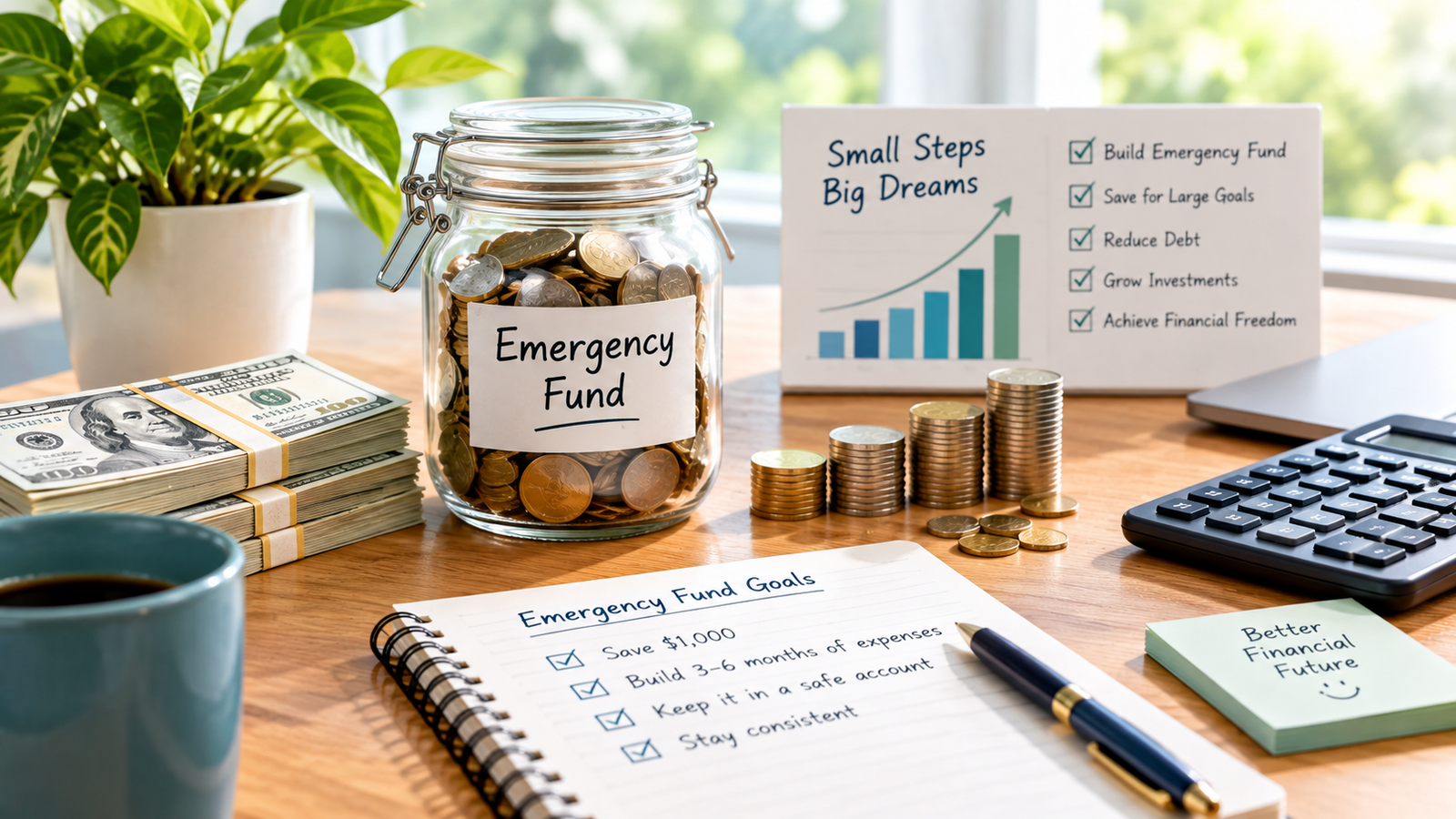
Build an Emergency Fund
An emergency fund is money set aside for genuine surprises: a car repair, a medical bill, a gap in income. It protects you from reaching for credit when something unexpected happens.
A common guideline is to build toward three to six months of essential expenses, but how much is right depends on your job stability, dependents, and circumstances. If that number feels distant, start with a smaller milestone, such as one month of essentials or even a modest starter amount. Progress matters more than the target.
Automate Savings
Set up a recurring transfer to savings on or just after payday. Automation removes the monthly decision, which is when most good intentions fail. Start with an amount you can sustain, even if it feels small, and increase it when your budget allows.
Create Separate Savings Goals
One big pile of savings makes it hard to know what it is for. Separate goals, such as an emergency fund, an annual insurance bill, a trip, or a laptop replacement, make progress visible and reduce the temptation to dip into money meant for something else. Many banks let you create named sub-accounts, and planners and apps often have goal trackers.
Reduce Unnecessary Spending
Look for spending that does not match your priorities. For example, if your tracking shows food delivery costs more than you expected, you might cap it rather than cut it entirely. Small, sustainable adjustments usually last longer than dramatic cuts.
Be realistic. Saving takes time, and results depend on income and circumstances. If your income is tight, focus on consistency over size.
Related guides: How to Start Saving Money · Emergency Fund Guide · Sinking Funds · How to Automate Savings · Saving Money on a Low Income
How to Manage Debt?
Debt management is the Manage Debt stage of the loop. The aim is simple: know what you owe, have a plan, and avoid making it bigger.
Know What You Owe
List every debt in one place. Here is an example format with made-up figures:
| Debt | Balance | Interest Rate | Minimum Payment |
|---|---|---|---|
| Credit card A | 1,200 | 22% | 40 |
| Credit card B | 600 | 18% | 25 |
| Personal loan | 3,500 | 9% | 120 |
| Student loan | 8,000 | 5% | 90 |
Figures are illustrative only.
Seeing everything together takes away some of the dread, and it shows you which debts are most costly.
Debt Snowball vs. Debt Avalanche
Both are ways of deciding where extra money goes after you pay all minimums.
Debt snowball: Pay extra toward the smallest balance first, then roll that payment into the next smallest. Its appeal is momentum: quick wins can be motivating.
Debt avalanche: Pay extra toward the highest interest rate first. It typically reduces the total interest paid, since the most expensive debt is cleared first.
Neither is universally better. Avalanche may cost less in interest, while snowball may help some people stay motivated. The best method is the one you will follow through on.
Include Debt Payments in Your Budget
Treat debt payments as a fixed line in your monthly plan, not something you pay “when you can.” Cover all minimums first. Late payments can mean fees and extra interest. Then decide how much extra, if any, goes toward your chosen method.
Avoid Adding Unnecessary New Debt
Paying down debt is harder when new balances keep appearing. If you use credit, a budget and expense tracking make it easier to see when spending is outpacing income. An irregular expenses fund and an emergency fund can reduce how often surprises land on a card.
Debt situations differ a lot. If you are struggling with payments, consider contacting your lender or a reputable nonprofit credit counseling service in your country.
Related guides: Debt Snowball vs. Debt Avalanche · How to Create a Debt Payoff Plan · How to Budget While Paying Off Debt · Debt Tracking Guide
How to Control and Track Subscriptions
Subscriptions are easy to start and easy to forget. Because they are small and automatic, they rarely trigger the same scrutiny as a big purchase, yet they repeat every month or year.
Common recurring costs include:
- Streaming services
- Software and apps
- Memberships and clubs
- Cloud storage
- Fitness memberships
- News, gaming, and other digital services
- Insurance add-ons and other recurring charges
Here is a simple way to see their true cost: Monthly cost × 12 = Annual cost.
A Simple Subscription Audit
| Subscription | Monthly Cost | Annual Cost | Usage | Keep/Review |
|---|---|---|---|---|
| Video streaming | 15 | 180 | Weekly | Keep |
| Music streaming | 10 | 120 | Daily | Keep |
| Cloud storage | 3 | 36 | Rarely checked | Review |
| Fitness app | 12 | 144 | Not used in 2 months | Review |
| Software trial that converted | 8 | 96 | Unknown | Review |
| Total | 48 | 576 |
Illustrative figures.
A few small charges add up to a meaningful annual amount. That does not mean every subscription should go. The point is to decide deliberately.
To run your own audit, check bank and card statements for recurring charges, list each one, calculate the annual cost, and mark what you use. Then set a reminder to repeat the review regularly, such as monthly or quarterly. A budget planner with a subscription section or an expense tracking app that flags recurring payments can help you keep this list current, but a simple spreadsheet works too.
Related guides: How to Audit Your Subscriptions · Subscription Tracker Guide · How Much Are Your Subscriptions Really Costing? · How to Reduce Recurring Expenses
How to Track Your Expenses
Expense tracking is the foundation of the loop. It turns your budget from a guess into a feedback system. There are three common methods, each with trade-offs.
Spreadsheet
Advantages: Free or low cost, fully customizable, and good if you enjoy formulas and building your own layout.
Limitations: You build and maintain it yourself, and entering transactions can become a chore without a routine.
Budget Planner
A budget planner, printable or digital, gives you a ready-made structure for budgeting, tracking, savings goals, and debt in one place. Some people prefer a physical or printable planner because writing things down makes spending feel more real. Others like digital planners that can be filled in on a tablet or computer. If you prefer a visual planning system, a planner can be a good fit.
Limitations: Entries are manual, so it takes some discipline.
Budgeting App
Apps can speed up expense tracking. Depending on the app, features may include:
- Mobile access
- Automatic categorization
- Bank syncing or other automation
- Quick expense entry
- Budget monitoring and alerts
Not every app offers every feature, and some features may require a paid plan or depend on your bank and region. Consider whether you are comfortable with how an app handles your financial data.
Limitations: Less manual engagement can mean less awareness for some people, and automatic categories sometimes need correcting.
Related guides: Budget Planner vs. Expense Tracker · How Often Should You Track Expenses? · Expense Tracking Apps · Digital Budget Planners · Budgeting Apps
Budget Planner vs. Budgeting App
Neither is universally better. Here is how they generally compare:
| Factor | Budget Planner | Budgeting App |
|---|---|---|
| Manual planning | Strong; you plan by hand or by typing | Varies; often more guided |
| Automation | Minimal | Often more, depending on the app |
| Expense tracking | Manual entry | Manual or automatic, depending on the app |
| Customization | High; you arrange it your way | Depends on the app’s options |
| Portability | Printable pages or a file | Usually on your phone |
| Visual planning | Often strong, with a full-page overview | Often charts and dashboards |
| Ease of use | Simple, but needs consistency | Easy to start; features vary |
| Best suited for | People who like writing, overview, and mindful spending | People who want speed, reminders, and mobile access |
Some people combine both: an app for quick daily entries and a planner for the monthly review. Others stick to one.
The tool matters less than whether you use it. A simple method you follow every week will beat a sophisticated one you abandon.
Related guide: Budget Planner vs. Budgeting App
Build a Simple Personal Finance System
Now put the pieces together into a repeating routine. This is the Review and Adjust part of the loop, and it is where good intentions turn into habits.
Daily (2–5 minutes)
- Record your expenses.
- Notice anything unusual, such as an unexpected charge.
Weekly (10–15 minutes)
- Review the week’s expenses.
- Check your budget categories to see which are on track.
- Identify spending you would like to change.
Monthly (30–60 minutes)
- Create or review next month’s budget.
- Review subscriptions.
- Transfer savings.
- Review debt progress.
- Compare planned vs. actual spending.
Every 3–6 Months
- Review your financial goals.
- Adjust the budget for changes in income or expenses.
- Review recurring expenses.
- Update savings targets.
Start small. If this feels like too much, begin with the weekly review only and add the rest over time. Consistency matters more than completeness.
Common Personal Finance Mistakes
- Not tracking expenses. Without data, budgets are guesses. Even a rough record is better than none.
- Creating an unrealistic budget. A budget with no room for fun or surprises is hard to follow. Build in flexibility.
- Forgetting irregular expenses. Annual bills and repairs are predictable. Set aside a little each month.
- Ignoring recurring subscriptions. Small charges add up quietly. Audit them regularly.
- Saving only what is left over. Often, nothing is left. Treat savings as a planned line item.
- Not having a debt repayment plan. Paying whatever you can, whenever, makes progress hard to measure. Pick a method and schedule.
- Setting vague financial goals. “Save more” is hard to act on. “Save 1,000 for emergencies by December” is clearer.
- Never reviewing the budget. Your life changes, so your budget should too.
- Using too many complicated tools. Three apps and two spreadsheets can become a burden. Simplify.
- Tracking without acting. Data is only useful if it informs a decision. After each review, change one thing.
A Simple Monthly Personal Finance Checklist
Beginning of the Month
- [ ] Review income
- [ ] Create or review the budget
- [ ] Set a savings target
- [ ] Plan debt payments
During the Month
- [ ] Track expenses
- [ ] Review spending weekly
- [ ] Monitor subscriptions and upcoming renewals
End of the Month
- [ ] Compare planned vs. actual spending
- [ ] Check savings progress
- [ ] Review debt progress
- [ ] Adjust next month’s budget
Personal Finance FAQs
Personal finance is the management of your money: income, spending, saving, debt, and financial goals. It includes budgeting, tracking expenses, building savings, and making plans for the future.
Start by calculating your monthly take-home income, then list your fixed, variable, and irregular expenses. Assign amounts to essentials, flexible spending, savings, and debt payments. Track what you actually spend, then adjust after the first month.
There is no single right amount. Some people use guidelines such as saving about 20% of income, but your best figure depends on income, expenses, debt, and goals. If that feels out of reach, start with a smaller amount you can sustain and increase it over time.
The easiest method is the one you will actually use. A spreadsheet, a budget planner, or a budgeting app can all work. Try one for a month and switch if it does not fit your routine.
It depends on your preferences. Planners suit people who like writing things down and seeing the full picture on a page. Apps suit people who want quick entry and mobile access. Some people use both.
Start by tracking spending to see where money goes. Then review subscriptions, compare recurring bills, and set limits on categories that feel out of line with your priorities. Small, sustainable changes tend to last longer than drastic cuts.
Start Building Your Personal Finance System Today
Personal finance does not require perfection. It requires a loop you can repeat:
Track → Budget → Save → Manage Debt → Review → Adjust
Start with one step this week. Track your spending for seven days, or list your subscriptions, or write down every debt in one place. Small, consistent actions build a system that works.
When you are ready for tools to support the routine, Blueprint Market offers budget planners, printable and digital templates, budgeting tools, and expense trackers designed to make this process simpler. Whether you prefer pen and paper, a digital planner, or an app-based approach, the best choice is the one that fits your routine.
- Explore budget planners to organize your monthly plan
- Browse printable and digital templates for visual planning
- Find a tracking tool that fits how you like to work
This article provides general educational information and examples. It is not personalized financial, tax, or legal advice. For guidance specific to your situation, consider consulting a qualified professional.